I wonder what grade Grammarly will give this post, probably a B. That’s good enough for me. What’s good enough for you?
Every collaboration involves a negotiation about what is good enough. Are we aiming for perfection, or even expecting it? Or, are we trying to shove something out before a deadline, or so we can get on to our next tasks?
One of the more freeing aspects of solo writing is getting to decide what is good enough without any external negotiations. The internal ones can be infernal enough. (You’d use infernal and internal in the same sentence?! What’s wrong with you?! Shh. It’s hot out, and I’m inside relaxing.)
There’s an analogous situation within the tech world. It isn’t a universal rule, but I think it is a good guideline.
“Scientists seek the answers. Engineers seek solutions.” Scientists get to dwell on truth. Engineers are tasked to resolve problems. Pursuing truth can be a never-ending endeavor. Resolving problems comes with deadlines. Take your pick; they are both valid.
I was an aerospace engineer at Boeing for 18 years. When a pilot sitting in a 747 at the airport gate wants to know what to do about the truck that sheared off ten feet of wingtip, they aren’t waiting for a study. They want a five-minute possible solution, not a five-year research study. While engineers chose a solution, the crew got the passengers back into the terminal so they could be re-routed, and the pilots could decide which maintenance facility to fly to. (It all worked out so well that the airplane flew without any issues. The passengers and management undoubtedly had a different perspective. When I was working in Research, we were more interested in truth as described by physics and mathematics.
Some of my writer friends seek perfection. As I described a friend’s work who is a poet, ‘They spend hours per word; I write about a thousand words an hour.’ I also describe the distinction as, ‘Give them a piece of wood, and they’ll hand you a sculpture. Give me a piece of wood, and I’ll give you a couple of pieces nailed together into something that is hopefully useful.’ Art versus houses. And yes, there are artful houses, and they are expensive.
Good enough is the most common advice I deliver after telling folks to stop talking about writing and just write. Chasing perfection is noble, but getting something publicly published provides the most immediate feedback. That’s not the recommended technique for legal documents, but is fine for most fiction.
Grammarly currently provides a 100-point scale after it analyzes one of my pieces. I usually write about a thousand words in an hour-long session, let Grammarly chug on it, notice its grade, follow a few of its suggestions, look at the updated score, then post the text into whatever destination is appropriate. I usually start with a score in the 70s to mid-80s, and bring it up about ten points by following its suggestions. Grammarly seeks perfection, frequently at the cost of voice. Besides, imperfections are a sign of humanity. Nice dodge, eh?
I know writers who can’t write as poorly as I do, according to Grammarly. They start in the 90s and aim for 100. Go for it. I’m actively editing Muddling By (non-fiction personal finance), prepping for the third book in the Firewatcher trilogy (sci-fi), trying to find a home for a screenplay (true life story about a 14-year-old brat on a tall ship in 1876), writing this and three other blogs, helping produce a podcast, and managing a YouTube channel. Good enough?
And I cheer my friends who get an A. Cool.
It’s late enough. I’ve edited Muddling By. There’s a large semi-annual post to prepare for one of the blogs. But, I’ll sit back, let Grammarly work, record the results here, publish the piece, and let you decide what grade you’d get and what grade you’d expect.
Gotta laugh. An 88? I must be having a good night.
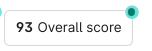
Wow. Ended up with a 93. An A day, eh?
 tomthewriter.com
Leave a comment