What to do in the gap between finishing the third draft of Muddling By (working title) and the fourth draft? Take a vacation, right? Ha! I did set aside the writing, but my brain popped up creating the book cover. As if there wasn’t enough to do writing the book.
Years ago, I heard some statistics about book covers at a writers conference. Sadly, I haven’t found the original data, but the numbers are clear enough to sound more like a guideline.
- 95% of book sales come from the front cover
- 3.5% of the book sales come from folks who check out the back
- 1% of book sales come from people who read the first page
- 0.5% of book sales come from people reading random selections by flipping through the pages
We say to not judge a book by its cover, but people do.
That data, or at least that story, is old enough that things have changed. Buyers are less likely to be browsing bookshelves and flipping through pages. They get a tiny icon on a screen. Other parts of the cover may never be seen, at least online.
A book cover should still look appealing, at least for art’s sake. The cover should convey something about the text; otherwise, go black & white and generic with courier font and a bar code and maybe a QR code. That sends the wrong message for almost every book except studies of bar codes and QR codes.
The trick is to create a book cover that looks good at both scales: on paper and on the screen.
One of my struggles with Muddling By is to make the title stand out when squinting at an icon while also looking appropriate for a non-fiction book about personal finance. That’s one reason I am struggling with the title. My two favorite ways of describing the book are “From Middle Class to Millionaire to Muddling By” and “A Rollercoaster Ride Through America’s Wealth Classes“. Too long, especially for the icon. Meanwhile, Muddling By fits, but it doesn’t reference personal finance. Those longer lines are useful as subtitles.
As with most of my books, the title will be enabled by me on a quiet day with a glass of wine and a big sheet of paper. Scribble. Scribble. Scribble. Then something pops out.
It won’t be a blank page. Under those letters will be art. For frugal me, it will probably be basic, hopefully classically simple, and maybe even with some elegance. I’m sparing you the details because I don’t want to reveal it yet, and it might change dramatically.
The front will probably be a simple graphic, but then I may let the more detailed and somewhat mathematical version take over the back.
Because this book ties into one of my other books, Dream. Invest. Live., I intend to keep the same color palette.
The back cover is where the blurbs go, more detailed descriptions, marketing text, etc.
Save room for the price, the genre, and the bar code. Some bookstores appreciate various elements. I add the genre to aid anyone stacking books. The bar code I consider as a requirement, besides, it looks more professional. I do Not, however, include a price. Some bookstores want that, but I’ve had too many bookstores add their own labels. If it is for a different price, the customer might get confused. Also, inflation happens. I leave it blank but keep the online version current. Oh yeah, and good luck printing a price if your book sells in other countries in other currencies.
Make the cover look pretty for the humans.
Include the right words for the search engines.
The publisher’s database should store keywords, descriptions, and blurbs that you load. The search engines should sift through them, but if possible, include the pertinent ones in the cover art, the title, and the stuff on the back cover. I doubt that I’ll use Muddling By as a title because – so many ways that can go wrong just flew through my brain.
Oh yeah, and think through which name you plan to use. I am Thomas Trimbath (official), T. E. Trimbath (gender neutral), Tom Trimbath (casual), and on social media: tetrimbath. Which of your names do you prefer? Good luck with pen names. My life is already complicated enough. I don’t need another name to keep track of, though using a pen name is one way to track spammers.
And remember the spine. Powerful on a crowded bookshelf. Little tiny space for printing.
And remember that all of that art has to fit into one page that is the book with a broken back. Back cover on the left, spine in the middle, front cover on the right. There’s probably a margin. Publisher’s templates help. I usually hire an excellent graphic illustrator to make sure my idea looks better and fits the publisher’s specifications.
E-books are easier, but you don’t get the opportunity to play with bigger art.
Covers are important, especially for new sales.
And here comes the kicker for the follow-on sales.
In my opinion, very successful books succeed because of what’s inside them. Book covers are like a flirt, an invitation to an invitation. But books sell because the people who bought the book without knowing much about it, read it, and then told other people to read it, regardless of the cover.
The cover is important for those first sales, but word-of-mouth is still the most powerful sales tool, and it relies on the book being worth reading. Spend that time working on the cover, or hiring it out, but make sure what you write is worth reading – assuming you want sales or at least to get your message out there.
For this next book, I’m pulling in some research help because I want to include some factual data as part of the art. I’m a contrarian; if facts are out of fashion, then I’ll include them. The data aren’t here, yet, which is why I wrote this post now. There’s always something to write about. There’s always something to do.
Personal Experience with my book covers:
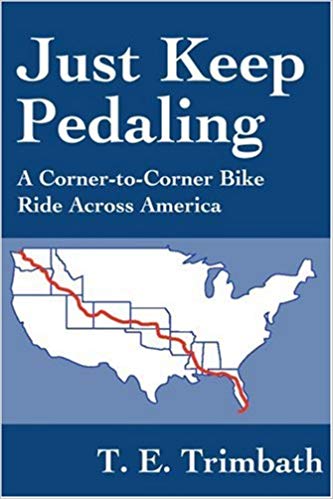


Just Keep Pedaling
Clear, easy to read, and it tells some of the story
As one friend said, it’s obvious you lived because the line goes from end to end.
Twelve Months at Barclay Lake, Lake Valhalla, Merritt Lake
Sigh, a failed attempt at branding a series. The colors weren’t consistent.
The titles were too generic, not descriptive.
The Wet West Side of Washington’s Cascades… may have been better.
The wrong font and color to show up.
Dream. Invest. Live.
Brighter contrast would’ve been better.
A good enough idea, but I let the publisher finish it. Maybe I should’ve done the work.
Walking Thinking Drinking Across Scotland
I’ve received compliments about this one, particularly the photo matched with the style and the topic.
Different coloring for the lettering, maybe.
I suspect Drinking and Scotland sell it.
Kettle Pot Cup
Folks like this cover too. Maybe I’m learning something.
The photo was surreptitious. I was photographing each, ran out of room, stacked them up, grinned, took the photo, and polished it a bit.
Firewatcher
The story of this cover deserves its own book. I’ve described it before. The short version is that, when I got an image in my mind, then saw the same image sketched out by a world-famous artist, and they agreed to let me use it – use it.
One advantage of life in a small town is that me, the painter, and the graphic illustrator all know each other. Teamwork.
Fire Race
Being the sequel to Firewatcher meant keeping a similar (though not exact) palette, iconography, etc.
 tomthewriter.com
Leave a comment