Pardon me as I groan. Inventory. Inventory is also known as books that haven’t sold. Inventory is also known as potential sales. Inventory can also be heavy, bulky, and fragile. It is also necessary. I’m glad I have so little, yet probably have enough, and maybe not. Writing is one set of skills. Keeping track of books is completely different. Inventory is on my mind because I am speaking at an expo, which is a good place to take books to sell, and because a good bookstore no longer wants to carry my books. Sadly, matching the two venues and events isn’t practical. Inventory is mostly about practicality.
The classic view is of an author storing hundreds or thousands of copies of their books in their garage, with more in the trunk of their car. Historically, self-published authors were required to buy a thousand copies or more to drive down the unit cost per book. Otherwise, the profit per book would be so low as to not make selling worthwhile. Whether in the car or in the garage, books are vulnerable to damage from water, being banged around, critters, and being forgotten. It was a do-it-yourself doorstop program. A box of books can keep many heavy doors open.
Print-on-demand now means that inventory can be as low as none. I self-publish through such services (iUniverse, kdp, Lulu, blurb). Sometimes, I will only buy one copy after the proof copy, just to make sure the process works. I don’t rely on bookstore sales. Online sales are more convenient, don’t require driving around to deliver books, and are effectively passive income. (Too passive in my case.) But that also means zero direct sales, which is disappointing for friends, family, and fans who want to buy a copy hand-to-hand, especially if they want it signed.
Usually, I buy a few dozen copies to hand out to helpers, prime some local bookstores, and to carry around in the car for serendipitous opportunities. They are as vulnerable to loss as any others, but I minimize that by minimizing how many I carry.
July 19-21, 2024 I will be a speaker at a sci-fi expo. The organizers expect on-site sales. I can’t blame them. People pay money to attend, pay money to buy books and merch, and then spread the word to their friends. It makes the event more memorable. Good. I’ll have books to sign and sell.
And I just got an email from Third Place Books, an author-friendly bookstore that carried some of my titles. Some sold. Some didn’t. They need to refresh their inventory and shelf space, so they have pulled the remaining copies for me to pick up, or they’ll donate them. Fine by me. Donate them. I now live about two hours further away. Driving to the store could cost more than the value of the books. Let the libraries have them. They are exposure, too.
It would seem to make sense to take the bookstore’s books and sell them at the expo. But I don’t do that. Remember those vulnerabilities? Add bookstores and particularly customers to the list. If a book has been on a shelf, I consider it used and won’t sell it for full price. Covers and pages get bent. Spills happen. At one bookstore, they proudly placed the books on brand new shelves – where the wood stain was soaked up by the pages. Used. Damaged. Lost profits.
And then there are returns, books that came back for some reason, possibly simply because they didn’t have time to read what they bought. OK. So maybe they didn’t like my writing. Returns may not require justification.
Currently I have written and produced 18 titles. That’s a lot of books. That’s a lot of money. That’s a lot of weight. At one book fair my books covered one of the long tables. It took a long time to set up and it took a long time to tear down. In the middle, people browsed, sometimes bought, and more often thumbed through a few pages, if they even stopped.
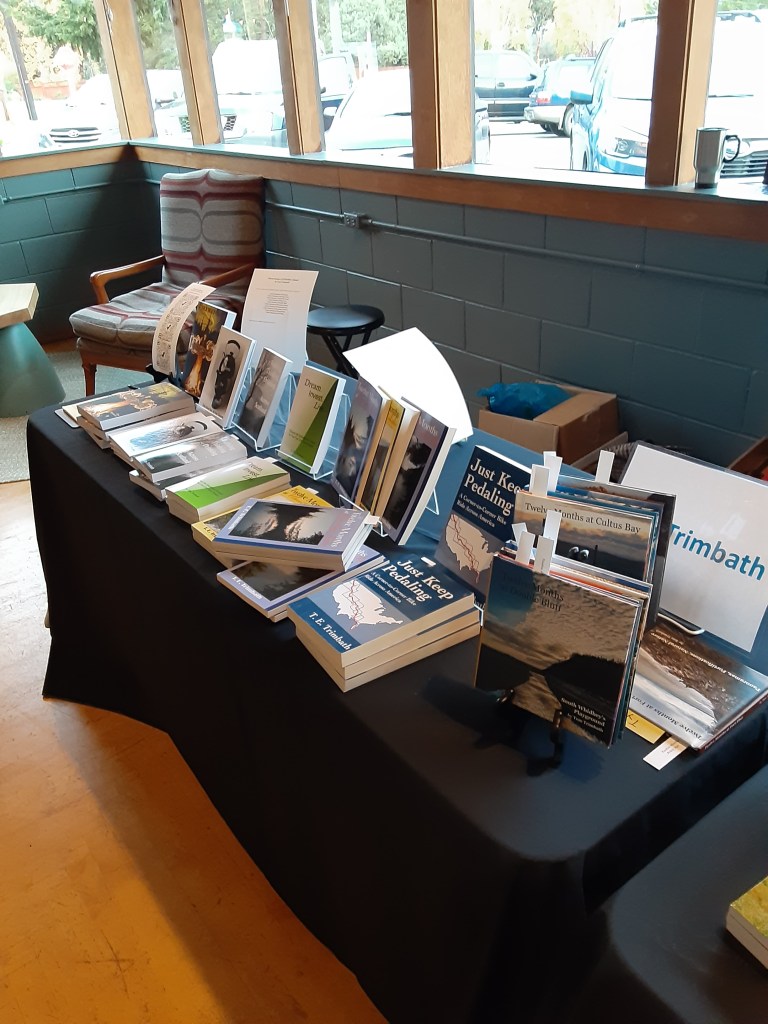
As a business, the issue comes down to the direct profits and the indirect exposure, and the direct costs.
And there’s more.
I enjoy public speaking and evidently do it well enough to be invited back. Whenever possible, I will share the front of the event with a book display. Add using them as props to more uses for inventory. I even hang onto battered copies to use as talking points, and as demos of the pluses and minuses of the business. I maintain a two-box travel kit of books, exhibits, and gear. More books for me to buy.
That is also more books to be stolen. At one event, my books were also part of a multi-author display. Someone stole one of the display copies. That’s a loss and a crime, but also a compliment. Of all the books to steal, they stole one of mine. Sadly, one time I was too in-cautious and used one of my first editions in the display. It was stolen. That happens, but that particular copy was unique. By a fluke, it was printed in the UK before the US. That copy is gone, and I suspect they don’t even know its value.
Inventory seemed so straightforward when I started. I’d written one book. I kept track of how many I ordered, sold, donated, and kept. It didn’t take long to lose track. Now, with 18 books, I don’t try. I simplify an event’s inventory by doing things like taking the same number of copies of each book, maybe emphasizing one title. If I sell enough, I buy more. If I don’t like the author discounts, I wait for online sales. It seems that sometimes Amazon plays with prices to see what price point is best. Drop it low enough, and I may buy a few or many.
A day or two before an event, I’ll review and refresh the two boxes of my travel kit. (Check those batteries for the pointers, and make sure the right cables are in there.) I’ll also fill two more boxes of inventory. Some will be fresh. Some books have been carried around to every event for several years. They’re well-traveled.
I’m not as well-prepared as usual. I recently moved, which was an opportunity to remind myself of the value, and particularly the weight and fragility of the inventory. I’m glad I have as little as I do, and am comfortable apologizing to attendees while pointing them off to Amazon. Sorry about the signature, eh?
Before and after publication is truly two sets of skills. Introvert versus extrovert. Cerebral versus physical. And both are necessary. Inventory is necessary, but the other one is more fun.
 tomthewriter.com
Leave a comment